Chapter 2. 이소영
요즘극장
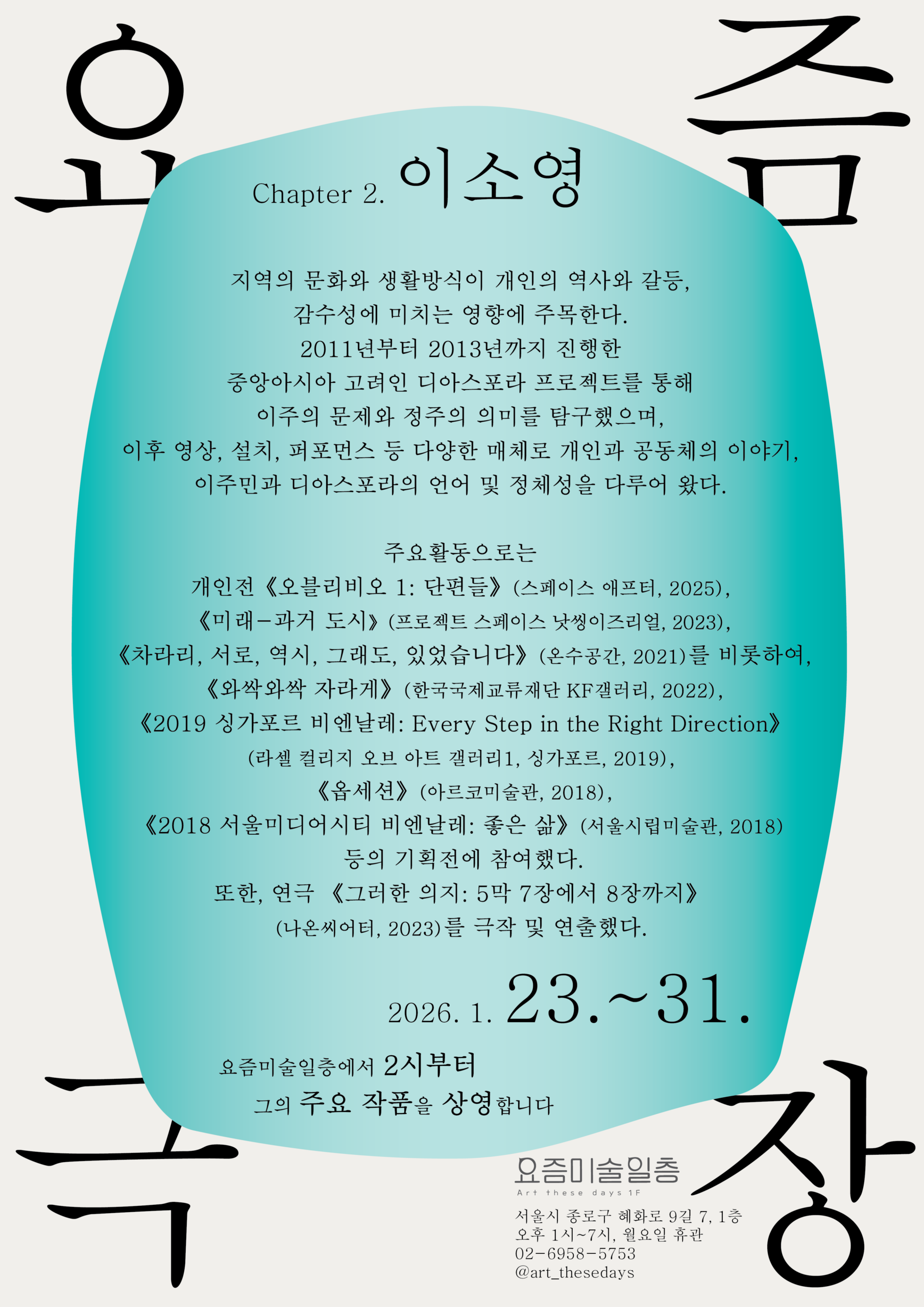
‘요즘극장’은 20년 이상, 시간을 동력으로 예술 활동을 하고 있는, 한 작가의 거의 ‘모든’ 작업들이 움직이고 있는 극장입니다. 이 극장에서는 작가 스스로 작업을 선별하고 순서를 정해 구성된 이야기를 볼 수 있습니다. 또한 미공개 작품이나 사적인 기록들까지 특별함이 수군대는 극장입니다. 상영시간을 잘 확인하세요. 하루 중 아주 잠깐, 혹은 종일 상영할지도 모릅니다.
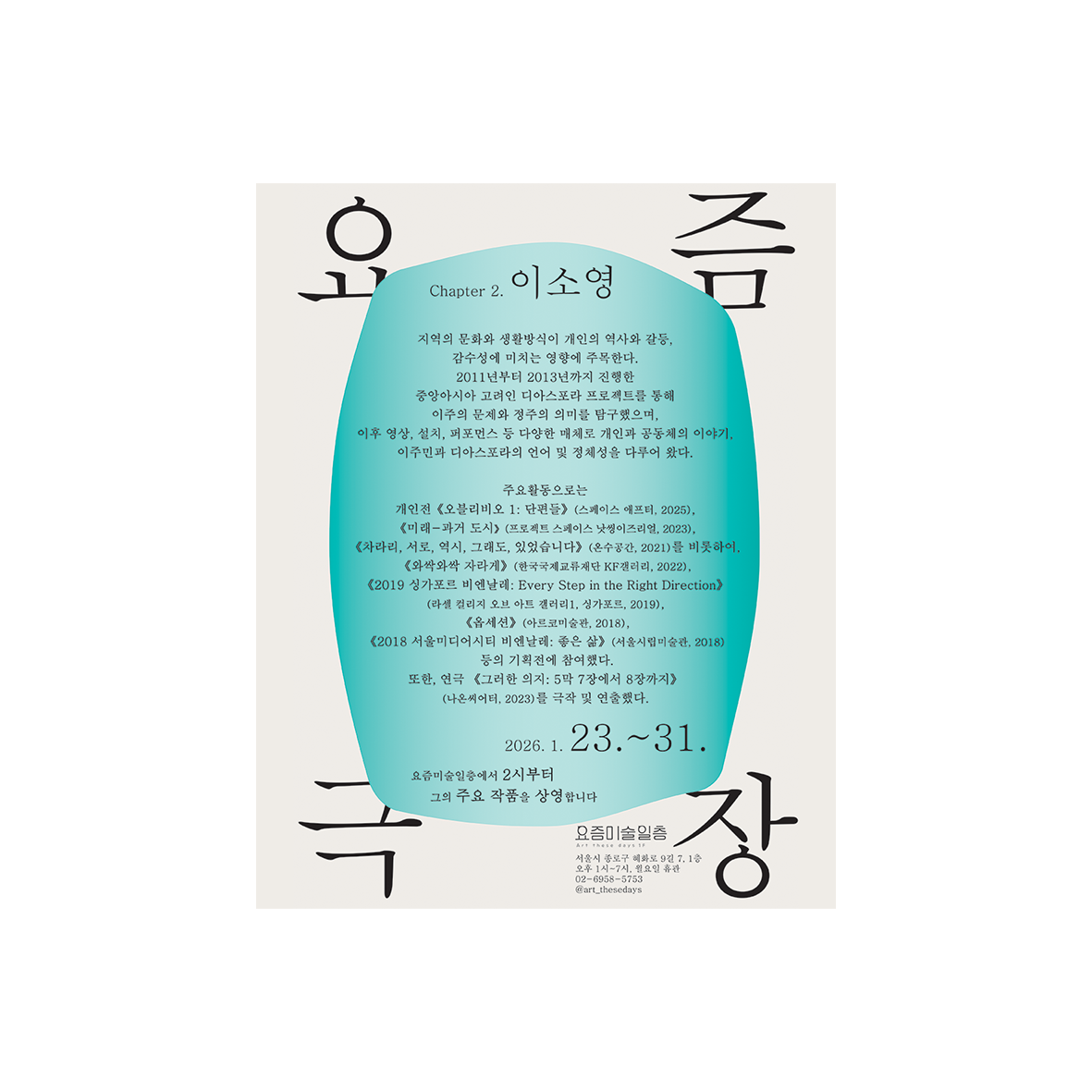
Chapter 2. 이소영
🟢 전시제목: 《요즘극장: Chapter 2. 이소영》
🟢 이소영 작가소개:
이소영은 지역의 문화와 생활방식이 개인의 역사와 갈등, 감수성에 미치는 영향에 주목한다. 2011년부터 2013년까지 진행한 중앙아시아 고려인 디아스포라 프로젝트를 통해 이주의 문제와 정주의 의미를 탐구했으며, 이후 영상, 설치, 퍼포먼스 등 다양한 매체로 개인과 공동체의 이야기, 이주민과 디아스포라의 언어 및 정체성을 다루어 왔다. 주요활동으로는 개인전《오블리비오 1: 단편들》(스페이스 애프터, 2025), 《미래-과거 도시》(프로젝트 스페이스 낫씽이즈리얼, 2023), 《차라리, 서로, 역시, 그래도, 있었습니다》(온수공간, 2021)를 비롯하여, 《와싹와싹 자라게》(한국국제교류재단 KF갤러리, 2022), 《2019 싱가포르 비엔날레: Every Step in the Right Direction》(라셀 컬리지 오브 아트 갤러리1, 싱가포르, 2019), 《옵세션》(아르코미술관, 2018), 《2018 서울미디어시티 비엔날레: 좋은 삶》(서울시립미술관, 2018) 등의 기획전에 참여했다. 또한, 연극 《그러한 의지: 5막 7장에서 8장까지》(나온씨어터, 2023)를 극작 및 연출했다.
🟢 기간: 2026년 1월 23일~31일(월요일 휴관)
🟢 시간: 오후 2시~5시
🟢 특별상영: 2026년 1월 24일, 31일/5시~6시30분
🟢 장소: 요즘미술일층
🟢 무료관람
🟢 Title:YOZM Theater: Chapter 2. Soyung Lee
🟢 Soyung Lee Bio:
Soyung Lee focuses on how regional culture and ways of life influence personal history, conflicts, and sensitivities. Through her Koryo-Saram Diaspora Project in Central Asia (2011–2013), she investigated issues of migration and the meaning of settlement. Since then, she has worked across video, installation, and performance to address the stories of individuals and communities, as well as the languages and identities of migrants and diasporas. Her recent solo exhibitions include Oblivio 1: Fragments (Space Aefter, 2025), Future-Past City (Project Space NOTHINGISREAL, 2023), Rather, One Another, As Expected, Nonetheless, Was There (Onsu Gonggan, 2021). She has also participated in group exhibitions such as Land of Hope (the Korea Foundation KF Gallery, 2022), Singapore Biennale 2019: Every Step in the Right Direction (Lasalle College of the Art Gallery 1, Singapore, 2019), Obsession (Arko Art Center, 2018), and the 2018 Seoul Mediacity Biennale: EU ZÊN (Seoul Museum of Art, 2018). In addition to her visual arts practice, she wrote and directed the play SUCH WILLS: From Act V, Scene 7 to Scene 8 (Naon Theater, 2023).
🟢 Dates: 2026 January 24~31, 2~5 pm(monday off)
🟢 Venue: Art these days 1F
🟢 Special Screening: January 24 and 31, 5 pm
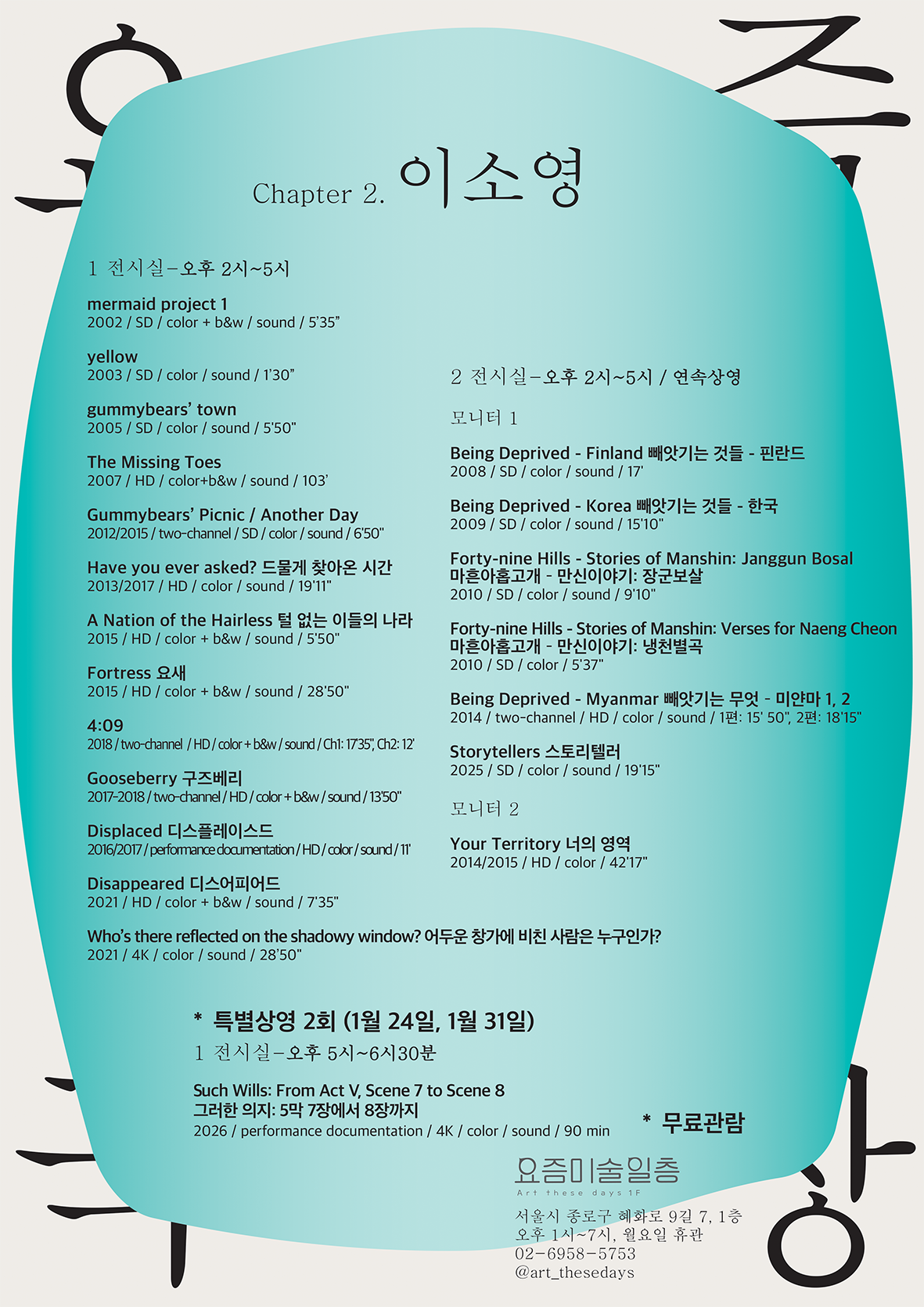
1 전시장
오후 2시~5시
〈mermaid project 1〉
2002 / SD / color + b&w / sound / 5’35”
다른 세계를 꿈꾸는 인간-인어의 이야기다. 그러나 동경하던 세계가 막상 현실이 되면, 환상이 깨지고 방향성을 잃은 공허함이 다시 자리한다. 그렇게 반복되는 꿈꾸기와 환상의 신화를 연극적이고 과장된 몸짓으로 표현했다. (영상의 텍스트: 프리드리히 니체 『차라투스트라는 이렇게 말했다』에서 인용)
(On-screen text: quoted from Friedrich Nietzsche, Thus Spoke Zarathustra)This is the story of a human–mermaid who dreams of another world. Yet when the longed-for world becomes reality, the illusion collapses, and a sense of emptiness—deprived of direction—returns. Through this recurring cycle of dreaming and disillusionment, the myth of fantasy is rendered through theatrical, exaggerated gestures.
〈yellow〉
2003 / SD / color / sound / 1’30”
환경과 강박적 심리를 다룬 작업이다. 광장공포증이나 폐쇄공포증과 같이 자신의 내부에 잠재하는 심리적 압박감, 태어나 살아온 곳과는 다른 환경에서 느끼는 이질감, 서식지를 벗어나고픈 욕망 등을 ‘옐로우’의 세계로 표현했다. 설치 작업인 박스 형태의 옐로우 룸 안에 전시했던 퍼포먼스 기록 영상이다.
This work explores environment and obsessive psychological states. Psychological pressures latent within the self—such as agoraphobia and claustrophobia—the sense of alienation felt in an environment different from one’s place of origin, and the desire to escape one’s habitat are expressed through the world of “yellow.” The video was filmed during the performance and later installed inside the “Yellow Room,” a box-shaped installation.
〈gummybears’ town〉
2005 / SD / color / sound / 5’50”
규범과 시스템이 존재하는 집단에서, 구성원들은 그에 따라 행동하는 부품처럼 느껴질 때가 있다. ‘Gummybear 마을’에서 일어나는 일도 그와 다르지 않다. 고문이나 화형과 같은 역사적인 처벌 장치들로 한 사회에 내재한 폭력성을 드러낸다.
Within groups governed by norms and systems, individuals may come to feel like components that function only according to prescribed roles. What occurs in the town of Gummybear is no different. Through historical instruments of punishment—such as torture and execution by burning—the work exposes the violence embedded within society.
〈The Missing Toes〉
2007 / SD / color / sound / 3’45”
이국적 간판, 상점, 골목, 축제, 이슬람사원 등 이태원의 문화적 특성이 배경이 된 이야기다. 주인공은 신체의 일부인 발가락을 잃어버린 당혹스러운 상황에서, 이태원 곳곳을 4일간 헤매며 사라진 발가락을 찾는다.
Set against the cultural landscape of Itaewon—with its exotic signboards, shops, alleyways, festivals, and a mosque—the work unfolds as a narrative. In a bewildering situation in which the protagonist has lost a toe, a part of their own body, they wander through various corners of Itaewon over the course of four days in search of the missing toe.
〈Gummybears’ Picnic / Another Day〉
2012/2015 / two-channel / SD / color / sound / 6’50”
Gummybear 구성원들에게 일어난 일련의 사건을 보여준다.
The work presents a series of events that unfold among the members of Gummybear.
〈Have you ever asked? 드물게 찾아온 시간〉
2013/2017 / HD / color / sound / 19’11”
예술가인 자식과 부모의 관계를 다룬 기획전 〈쭈뼛쭈뼛한 대화〉(아트선재센터, 2013)에서 발표한 영상이다. 일정 기간 부모님과 나눈 손글씨의 내용을 대본으로 각색하고, 9명의 배우가 각기 다른 연령대의 부모와 딸 역할을 맡아서 연기했다. 이들의 목소리는 이후 세 명의 voice-over 배우가 연령대의 차이 없이 같은 음색으로 더빙했다.
This video was presented as part of the curated exhibition Our Hesitant Dialogues (Art Sonje Center, 2013), which explored the relationship between artist children and their parents. Handwritten exchanges between the artist and their parents over a period of time were adapted into a script, and nine actors performed the roles of parents and daughters across different age groups. Their voices were later dubbed by three voice-over actors, all using the same vocal tone regardless of age.
〈A Nation of the Hairless 털 없는 이들의 나라〉
2015 / HD / color + b&w / sound / 5’50”
‘털 없는 이들의 나라’라는 가상의 시공간을 살아가는 주인공이 자신의 몸에 털 한 가닥이 돋아나자, 스스로가 인류의 퇴화를 상징한다고 믿는다.
Living in a fictional time and place known as A Nation of the Hairless, the protagonist comes to believe that they symbolize the degeneration of humankind when a single strand of hair begins to grow on their body.
〈Fortress 요새〉
2015 / HD / color + b&w / sound / 28’50”
동시대를 살아가는 개개인의 이주와 상주에 대한 고민, 즉 지금 사는 곳과 앞으로 살아갈 곳에 대한 고민을 담았다. 공동체에 가까운 ‘요새’라는 영역에서 다섯 명의 배우는 자신을 보호하기 위해 훈련하고, ‘보호막, 울타리, 보금자리, 터’라는 개념에 비추어 ‘어디에서 살지? 지금 여기는 괜찮은가? 어디에서 죽을 것인가?’라는 질문에 각자의 생각을 담아서 답한다. 한국에서 살아가는 방글라데시 이주민들이 배우로 참여했고, 몽골 가수가 엔딩곡을 노래했다.
The work reflects on the concerns of individuals living in contemporary societies regarding migration and settlement—that is, questions of where one lives now and where one might live in the future. Within a territory resembling a communal “fortress,” five performers undergo training to protect themselves and, through the concepts of “shield,” “fence,” “shelter,” and “ground,” articulate their own responses to the questions: “Where should I live? Is this place acceptable for now? Where will I die?” Among the performers are Bangladeshi migrants living in Korea, and the ending song is performed by a Mongolian singer.
〈4:09〉
2018 / two-channel / HD / color + b&w / sound / Ch1: 17’35”, Ch2: 12′
2018년 아르코미술관에서 열린 〈옵세션〉전(이성휘 기획)에서 발표한 작품이다. 하나의 일관된 주제가 아니라, 기획자가 참여 작가마다 개별적인 주제를 부여하는 독특한 형식의 프로젝트였다. 주어진 주제는 페데리코 펠리니의 영화 〈8과 1/2〉(1964년)과 하랄드 제만이 같은 제목으로 기획한 전시(1969년)였고, 제시된 키워드는 ‘창작자의 모순, 갈등, 고독’이었다. 펠리니와 제만이 창작물의 수와 연도를 따라서 제목을 지었다면, 〈4:09〉는 새벽과 오후 4시 9분을 뜻한다. 이를 창작자들이 꿈과 상념, 망상에 빠질 수 있는 조금 나른한 시간으로 설정하고, 기획자, 배우, 작가로서 동시대의 창작자가 겪는 고민과 생각을 등장인물들의 대화와 독백에 담았다.
This work was presented in the exhibition Obsession, held at the ARKO Art Center in 2018 and curated by Sunghui Lee. Rather than centering on a single overarching theme, the project adopted an unconventional format in which the curator assigned a distinct theme to each participating artist. The theme given to me was Federico Fellini’s film 8½ (1964) and the exhibition of the same title curated by Harald Szeemann in 1969, with the key concepts being “the creator’s contradictions, conflicts, and solitude.” While Fellini and Szeemann titled their works according to the number and year of their creations, 4:09 refers to 4:09 a.m. and 4:09 p.m. These moments are conceived as slightly languid times when creators may drift into dreams, reveries, or delusions. Through the dialogues and monologues of its characters, the work reflects the concerns and thoughts experienced by contemporary creators in their roles as curator, performer, and artist.
〈Gooseberry 구즈베리〉
2017-2018 / two-channel / HD / color + b&w / sound / 13’50”
〈구즈베리〉는 2017년부터 2018년에 제작한 두 편의 2채널 설치 영상을 묶은 제목이다. 두 개의 이야기가 1, 2부로 나뉘어 순차적으로 펼쳐지는데, 2개의 스크린은 두 이야기에 담긴 분할된 시각과 장소를 보여주기 위한 장치가 된다. 1편 〈털 없는 이들의 나라〉는 같은 제목의 2015년 작의 텍스트를 기반으로, 2016년과 2017년에 중국 상해와 한국에서 제작했다. 2편 〈피식자〉는 수평적으로 공생하기 어려운 관계로 얽힌 존재들, 즉 두 종(species) 간의 갈등을 다룬 이야기이며 서울과 싱가포르를 오가며 제작했다. 두 편의 이야기 모두 아주 사소하고 미세한 문제(1편 – 털, 2편 – Q라는 작은 존재)가 하나의 계기가 되어 종의 문제, 인류의 진화 등 확장된 서사로 연결된다. 장소의 다양성과 배경의 구조 또한 중요한 요소로 등장하는데, 상해, 서울, 싱가포르 등 빠르게 개발된 아시아 도시를 배경으로 촬영했다.
Gooseberry is the collective title for two-channel installation videos produced between 2017 and 2018. The two narratives unfold sequentially as Parts I and II, with the dual-screen format functioning as a device to present divided perspectives and locations embedded in each story. Part I, A Nation of the Hairless, is based on the text of the 2015 work of the same title and was produced in Shanghai, China, and Korea between 2016 and 2017. Part II, Edibles, tells the story of beings entangled in relationships that are difficult to sustain horizontally in coexistence—namely, conflicts between two species—and was produced between Seoul and Singapore. In both works, seemingly trivial and minute elements (Part I: hair; Part II: a small entity referred to as “Q”) serve as catalysts that expand into broader narratives concerning species and the evolution of humankind. The diversity of locations and the structural conditions of their backgrounds also play a significant role: the works were filmed in rapidly developed Asian cities such as Shanghai, Seoul, and Singapore.
〈Displaced 디스플레이스드〉
2016/2017 / performance documentation / HD / color / sound / 11′
홍콩 비디오타지(Vidoetage) 퓨즈(FUSE) 레지던시에서 제작한 이 작품은, 홍콩 가정에 입주해서 생활하는 필리핀 가사 도우미들과 홍콩 배우, 디즈니랜드에서 공연하는 캐나다인 댄서로 구성된 6명의 퍼포머가 참여하여 광둥어, 중국어, 필리핀어(따갈로그), 영어로 서로의 언어와 정체성을 더빙한 퍼포먼스의 기록 영상이다. 과거 소 도축장이었고 현재 홍콩의 문화유산으로 보호되는 ‘Cattle Depot Artist Village 오픈스페이스’를 무대로, 50여 명의 관객들 앞에서 공연한 현장의 실황을 담았다. 서로의 언어를 더빙하는 과정을 통해 중국 반환 이후 언어의 문제로 대두되는 광둥어의 지속력, 다문화 속에서 소통되는 언어와 소수자들의 정체성, 외국인 가사 도우미의 거주권 문제 등 현재 홍콩, 또는 다국적 문화가 중첩된 현대 사회가 대면한 문제의식과 이 안에서 살아가는 사람들의 한 단면을 그리고자 했다.
Produced during the FUSE residency at Videotage in Hong Kong, this work documents a performance involving six performers: Filipino domestic workers living in Hong Kong households, a Hong Kong actor, and a Canadian dancer performing at Disneyland. Through Cantonese, Mandarin Chinese, Filipino (Tagalog), and English, the performers dub one another’s voices, languages, and identities. The performance was staged before an audience of approximately fifty at the open space of Cattle Depot Artist Village, a former cattle slaughterhouse now preserved as a cultural heritage site in Hong Kong, and this video records the live event. By engaging in the act of dubbing one another’s languages, the work addresses the persistence of Cantonese as a linguistic issue following the handover of Hong Kong to China; the communication of language and minority identities within a multicultural society; and the residency rights of foreign domestic workers—reflecting concerns faced by Hong Kong and, more broadly, contemporary societies shaped by overlapping multinational cultures.
〈Disappeared 디스어피어드〉
2021 / HD / color + b&w / sound / 7’35”
정치적인 이유로 사라진 사람들의 이야기를 다룬 이 작품은 상해와 서울을 오가며 제작했다. 중국 상해의 외국인 커뮤니티를 통해 만난 참여 배우와 안무가는 아르헨티나인, 영국인, 프랑스인, 중국인이었고, 콜롬비아인 탱고 댄서가 서울에서 안무와 퍼포먼스로 참여했다. 각자의 언어인 중국어, 영어, 프랑스어, 스페인어로 내레이션을 이어가는 배우들과 홀로 탱고를 추는 두 명의 댄서가 끝내 돌아오지 못하고 잊혀간 사람들의 목소리를 대변한다. 전작인 〈디스플레이스드〉에 삽입된 노래 “I’m Displaced”에 2절의 가사를 추가하고, 이를 아르헨티나 뮤지션이 편곡해서 가창했다.
This work addresses the stories of people who disappeared for political reasons and was produced between Shanghai and Seoul. The participating actors and choreographer I met through Shanghai’s expatriate community were Argentine, British, French, and Chinese, while a Colombian tango dancer took part in the choreography and performance in Seoul. Actors delivering narration in their respective languages—Chinese, English, French, and Spanish—together with two dancers performing tango solos, stand in for the voices of those who never returned and were ultimately forgotten. The song “I’m Displaced,” originally included in the previous work Displaced, was expanded with a second verse, then rearranged and performed by an Argentine musician
〈Who’s there reflected on the shadowy window? 어두운 창가에 비친 사람은 누구인가?〉
2021 / 4K / color / sound / 28’35”
코로나 시기에 제작한 〈어두운 창가에 비친 사람은 누구인가?〉는 한자리에 잠시 모인 사람들이 나누는 이야기, 어쩌면 일방적인 독백, 창틀 밖으로 바라보는 눈빛과 표정, 몸짓의 기록이다. 다수와 소수는 개인이 선택하는 것이 아니라 각 나라와 지역의 정치, 경제, 민족 공동체의 권력에 의해 결정된다. 한국 사회의 틀 안에서 다수와 소수의 경계에 살아가는 방글라데시 배우와 몽골 배우, 노인, 어린이, 연극배우가 이 작업에 퍼포머로 참여했다. 한 사람씩 각자 앉은 자리, 혹은 서 있는 자리에서 자신의 창틀을 보호막처럼 두른 채 이야기를 나눈다. 〈디스플레이스드〉와 〈디스어피어드〉의 후속작으로 기획하면서, 두 작품에 삽입된 노래 “I’m Displaced”의 멜로디를 편곡해서 사용하고 가사는 수어로 전달했다.
Produced during the COVID-19 pandemic, Who’s there reflected on the shadowy window? records the stories exchanged by people who briefly gather in one place—often in the form of one-sided monologues—as well as their gazes directed beyond the window frame, their facial expressions, and their gestures. The distinction between majority and minority is not a matter of individual choice, but is shaped by political, economic, and communal power structures within each nation and region. Participating as performers in this work are Bangladeshi and Mongolian actors living at the boundary between majority and minority within Korean society, alongside an elderly person, a child, and theatre actors. Each person speaks from their own seated or standing position, enclosing the window frame like a protective barrier as they share their stories. Conceived as a sequel to Displaced and Disappeared, the work rearranges the melody of the song “I’m Displaced,” previously featured in both works, while its lyrics are conveyed through sign language.
특별상영 2회: 24, 31일 / 5~6시30분
〈Such Wills: From Act V, Scene 7 to Scene 8 그러한 의지: 5막 7장에서 8장까지〉
2026 / performance documentation / 4K / color / sound / 90′
공연이 하나 끝난 후 그리고 다음 공연이 시작되기 전, 막이 내린 무대에 남아 있는 배우와 스태프, 무대 소품 등 여러 층위의 개체들이 그려내는 무대 이면의 이야기다. 공연이 끝난 무대는 불 꺼진 거리 풍경처럼 다소 정체된 느낌으로 남겨진다. 무대 위의 오브제, 배경, 사람들이 해산하고 해체되기 전에, 여전히 현장에 남은 이들이 사유하며 연결되고 재가동하는 모습을 그리고자 했다. 따라서, 이 무대는 현장의 뒷면, 뒤(Behind)와 후(After)를 다루는 이야기인 동시에 여전히 기능을 멈추지 않은 잔존 세력들의 장이다.
After one performance has ended and before the next begins, this work unfolds a story of what lies behind the stage, shaped by multiple layers of presence—actors, staff, and stage props that remain after the curtain has fallen. Once the performance concludes, the stage is left in a somewhat suspended state, like a darkened streetscape. Before the objects, scenery, and people on stage disperse and are dismantled, the work seeks to depict those who still remain on site as they think, reconnect, and re-activate. In this sense, the stage becomes both a narrative of the behind and the after, and a field inhabited by residual forces that have not yet ceased to function.
2 전시장
모니터 1 | 연속상영
〈Being Deprived – Finland 빼앗기는 것들 – 핀란드〉
2008 / SD / color / sound / 17′
핀란드 남부 투르쿠시에서 시작한 인터뷰 시리즈로, “빼앗김”의 상황에서 응답자들이 이를 얼마나 의식하고, 각자 어떤 행동을 취하는지 질문한다. 인터뷰에는 전시장을 찾아온 방문객과 지역 주민들이 즉흥적으로 참여했다. 전시장 내부에는 간단한 세트를 설치했다. 의자가 놓인 뒤쪽 벽면에는 투르쿠시의 일상적인 모습과 관광 명소를 촬영한 영상을 투사했는데, 참여자들이 직접 원하는 장소의 영상을 배경 화면으로 선택할 수 있었다. 전시장 입구에도 모니터가 설치되어, 인터뷰가 진행되는 동안 관객이 이 과정을 볼 수 있는 구조였다. 인터뷰에 참여한 이들에게 다음과 같이 질문했다. “누군가, 혹은 무엇인가가 당신에게서 무엇인가를 빼앗으려 합니다. 당신은 무엇을 빼앗기고 있습니까? 또 이때, 어떤 기분이 들고 어떻게 이 상황에 대처하십니까?”
Initiated in the southern Finnish city of Turku, this interview series explores how respondents perceive situations of “being deprived” and what actions they take in response. Exhibition visitors and local residents participated spontaneously. Inside the exhibition space, a simple set was installed. On the wall behind a chair, projected footage depicted everyday scenes and tourist landmarks of Turku, from which participants could select their preferred location as a background during the interview. A monitor was also installed at the entrance to the exhibition space, allowing visitors to observe the interview process as it unfolded. Participants were asked the following question: “Someone, or something, is trying to take something away from you. What is being taken from you? How does this make you feel, and how do you respond to this situation?”
〈Being Deprived – Korea 빼앗기는 것들 – 한국〉
2009 / SD / color / sound / 15’10”
한국에서, 인터뷰에 참여한 이들에게 같은 질문을 했다. “누군가, 혹은 무엇인가가 당신에게서 무엇인가를 빼앗으려 합니다. 당신은 무엇을 빼앗기고 있습니까? 또 이때, 어떤 기분이 들고 어떻게 이 상황에 대처하십니까?”
In Korea, the following question was posed to interview participants: “Someone, or something, is trying to take something away from you. What is being taken from you? How does it make you feel, and how do you respond to this situation?”
〈Forty-nine Hills – Stories of Manshin: Janggun Bosal 마흔아홉고개 – 만신이야기: 장군보살〉
2010 / SD / color / sound / 9’10”
〈Forty-nine Hills – Stories of Manshin: Verses for Naeng Cheon 마흔아홉고개 – 만신이야기: 냉천별곡〉
2010 / SD / color / 5’37”
2010년 제3회 안양공공예술프로젝트(APAP)에 안양 5동에 기반을 둔 ‘오동팀’의 일원으로 참여했다. 안양 5동에서 일 년여를 작업하며, 이 동네의 두드러진 특성 중 하나인 수많은 만신 집을 보았다. 당시 지도에 표기되지 않았던 이들의 위치를 표기해서 만신 지도를 만들며, 총 49여 개의 만신 집을 발견했다. 그중 방문을 허락한 몇몇 만신들에게 재개발에 묶여 있는 안양 5동의 미래를 점쳐 달라고 문의했다. 이때 제작한 총 3편의 인터뷰 영상 중에서 〈장군보살〉편과 이 과정에서의 소회를 정리한 텍스트 기반 작업 〈냉천별곡〉을 상영한다.
In 2010, I participated in the 3rd Anyang Public Art Project (APAP) as a member of the Odong Team, based in Anyang 5-dong. Working in the neighborhood for about a year, I noticed one of its striking characteristics: the presence of numerous mansin (Korean shamans)’ residences. By marking locations that were not indicated on official maps, I created a mansin map and identified a total of forty-nine such sites. I asked a few mansin who welcomed my visit to foretell the future of Anyang 5-dong, a neighborhood bound by redevelopment plans. From the three interview videos produced through this process, the chapter Janggun Bosal is screened, along with the text-based work Verses for Naengcheon, which reflects on the experiences of the project.
〈Being Deprived – Myanmar 빼앗기는 무엇 – 미얀마 1, 2〉
2014 / two-channel / HD / color / sound / 1편: 15’50”, 2편: 18’15”
미얀마 양곤에서, 인터뷰에 참여한 이들에게 질문했다. “누군가, 혹은 무엇인가가 당신에게서 무엇인가를 빼앗으려 합니다. 당신은 무엇을 빼앗기고 있습니까? 또 이때, 어떤 기분이 들고 어떻게 이 상황에 대처하십니까?”그리고, 인터뷰 사이에 그들이 전해주는 미얀마의 설화를 엮어 넣었다.
In Yangon, Myanmar, the following question was posed to interview participants: “Someone, or something, is trying to take something away from you. What is being taken from you? How does it make you feel, and how do you respond to this situation?” Interwoven between the interviews are Myanmar folktales shared by the participants.
〈Storytellers 스토리텔러〉
2025 / SD / color / sound / 19’15”
2025년에 ‘사회적 망각’을 주제로 한 장기 프로젝트의 첫 결과물을 개인전 〈오블리비오 1: 단편들〉(스페이스 애프터)에서 전시했다. ‘망각이 뇌의 자연스러운 현상일 뿐 아니라 사회적 영향이나 외부에 의해 통제되거나 왜곡된다면, 개인의 의지와 선택으로 이에 개입할 가능성도 있지 않을까?’라는 의문에서 시작한 작업이다. 그중에서, 인터뷰이 2명의 목소리로 개인이 소장한 기억의 단편을 담은 작업이다. 인터뷰이들의 음성과 자막만 설치했었던 전시 버전이 아닌, 영상과 함께 편집한 첫 편집본을 상영한다. 삽입된 영상은 6mm 카메라 테이프에서 발견한, 옛 작업실의 동료들이 번갈아 찍은 걸로 추정되는 푸티지들이다.
In 2025, the first outcome of a long-term project centered on the theme of “social forgetting” was presented in the solo exhibition Oblivio 1: Fragments (Space Aefter, Seoul). The project began with the question of whether forgetting, beyond being a natural function of the brain, can also be controlled or distorted by social influences or external forces—and if so, whether it might be possible to intervene in this process through individual will and choice. Among the works presented, this piece gathers fragments of privately held memories through the voices of two interviewees. Rather than the exhibition version, which consisted solely of audio and subtitles, this screening presents the first edited version incorporating video. The inserted footage was discovered on 6mm camera tapes and is presumed to have been filmed alternately by the colleagues in the former studio.
모니터 2 | 연속상영
〈Your Territory 너의 영역〉
2014/2015 / HD / color / 42’17”
미얀마의 어느 지역에나 길거리를 배회하는 개들이 있다. 사람이 키우지 않는 개들은 순종적이지도 공격적이지도 않다. 도시 내 한쪽 코너가 주거지가 되고, 두어 블록 정도를 맴돌며 생활권을 유지한다. 자유로워 보이지만 이 영역을 쉽게 벗어나지 않는다. 사람이 도시를 장악하면 그 외의 모든 것들이 사람을 위해 존재하게 되고 나머지 동식물들은 그 안에서 생존해야 한다. 반려동물은 보호 대상이고, 쥐나 바퀴벌레는 소탕 대상이다. 촬영 내내, 인간이 동물, 혹은 사물과 함께하는 것, 공간을 공유하는 것, 서로 위협이 되지 않는 것, 함께 사는 것에 대해 생각했다.
In many parts of Myanmar, stray dogs wander the streets. Dogs not raised by humans are neither obedient nor aggressive. Certain corners of the city become their living areas, within which they circulate, maintaining their daily territories across a few blocks. Although they appear free, they rarely leave these boundaries. When humans dominate a city, everything else comes to exist for human purposes, and all other plants and animals must survive within that framework. Companion animals are protected, while rats and cockroaches are exterminated. Throughout the filming process, I reflected on what it means for humans to coexist with animals—or even with objects—to share space, to not pose a threat to one another, and ultimately, to live together.